
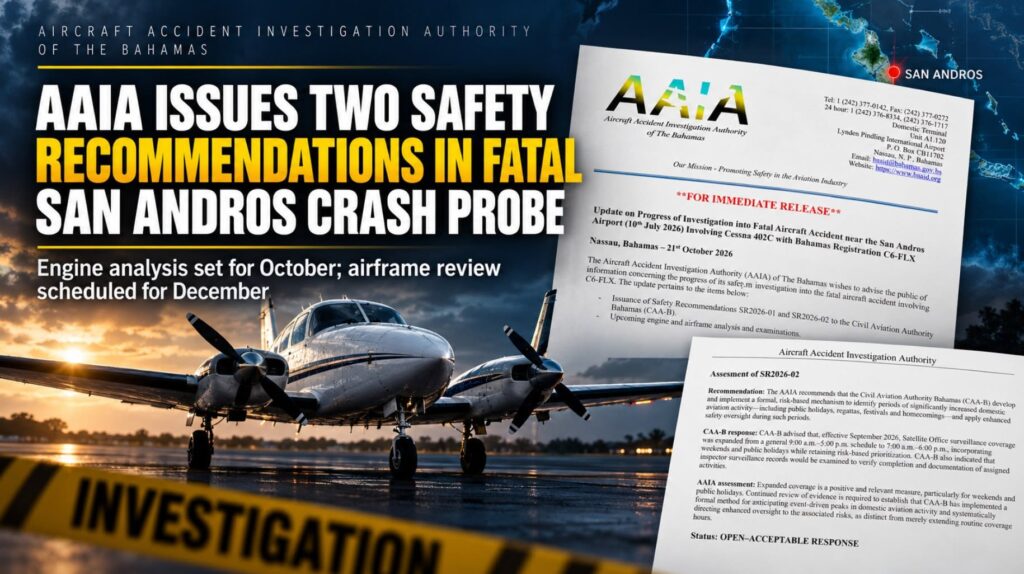
The Aircraft Accident Investigation Authority has issued two safety recommendations to the Civil Aviation Authority Bahamas as part of its ongoing investigation into the July 10 Cessna 402C crash near San Andros Airport that killed all 10 people aboard.
The recommendations call for stronger regulatory oversight of aviation operators and increased surveillance during periods of heavy domestic air traffic, including public holidays, regattas, festivals and homecomings.
The first recommendation calls for CAA-B to establish a documented, risk-based system that would trigger increased regulatory attention when the number, frequency, severity or pattern of safety-related events involving a regulated entity reaches defined thresholds.
CAA-B told investigators that it already uses occurrence trends, compliance histories, audit findings and corrective-action performance to prioritise oversight and is now formalising a documented Safety Event Triggering and Escalation Mechanism.
AAIA said the response addresses the intent of the recommendation, but the matter remains open while investigators review the completed procedure and evidence showing that it is being consistently applied.
The second recommendation calls for a formal mechanism to identify periods of significantly increased domestic aviation activity and apply enhanced oversight during those times.
CAA-B said surveillance coverage at its Satellite Office was expanded in September from a general 9 a.m. to 5 p.m. schedule to 7 a.m. to 6 p.m., including weekends and public holidays where risk-based prioritisation requires additional coverage.
AAIA described the expanded hours as a positive measure, but said further evidence is needed to show that CAA-B has implemented a formal system for anticipating event-driven increases in domestic aviation activity and directing enhanced oversight accordingly.
Both recommendations have been classified as OPEN–ACCEPTABLE RESPONSE, meaning AAIA considers CAA-B’s stated or proposed action responsive, but the recommendations remain open for further review.
The investigation into Cessna 402C C6-FLX is also entering another technical phase.
AAIA said investigators, representatives of the aircraft and engine manufacturers and officials from the U.S. National Transportation Safety Board and Federal Aviation Administration will participate in an engine analysis in Mobile, Alabama, from October 26 to 31.
An airframe analysis is scheduled for December 14 to 16 in Jacksonville, Florida.
AAIA’s earlier preliminary report showed the aircraft descending toward Runway 12 at approximately 300 feet and about 62 knots before its left wing struck tall pine trees. The aircraft was configured for landing with its flaps and landing gear extended.
The preliminary report did not determine a probable cause, and the latest AAIA update still does not identify what caused the accident.