
NASSAU| Two international technical reports have identified gaps in The Bahamas’ weather monitoring infrastructure, providing important context for the Bahamas Aviation, Climate and Severe Weather Network (BACSWN) project.
The reports, prepared in October and November 2024 under the United Nations Systematic Observations Financing Facility (SOFF), examined the country’s existing weather observation systems, radar equipment and forecasting capabilities.
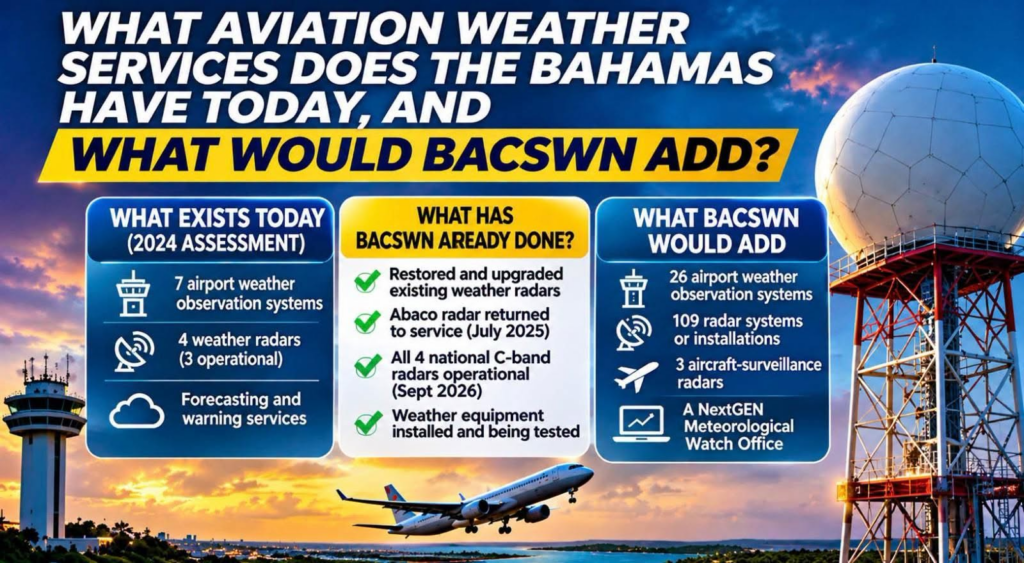
According to the October assessment, the Bahamas Department of Meteorology operated seven airport weather observation systems and maintained four weather radars, three of which were operational at the time.
However, the assessments identified ageing equipment, maintenance challenges and gaps in weather monitoring across the Family Islands.
The November report also revealed that the country’s upper-air observation station in Nassau had been out of operation for several years because of equipment problems. It further noted that eight of 15 new automatic weather stations had been installed at the time.
*WHAT HAS BACSWN ALREADY DONE?*
BACSWN’s involvement has extended beyond its proposed expansion.
The company has worked with the Department of Meteorology on restoring, maintaining and upgrading existing Government weather radar infrastructure, including reported work on the Abaco and Mayguna radars.
BACSWN has also reported progress on weather monitoring equipment and systems undergoing installation and testing as part of the wider project.
However, the precise operational status of those newer systems, including which have completed testing and entered service, has not been independently established.
*WHAT WOULD BACSWN ADD?*
BACSWN has outlined plans for 26 airport weather observation systems, 109 radar systems or installations, three aircraft-surveillance radars and a NextGEN Meteorological Watch Office.
The project aims to improve weather forecasting, storm monitoring, aircraft surveillance and the availability of aviation weather information throughout the archipelago.
For a country where aviation connects widely separated islands, expanded weather observations and improved forecasting could provide important benefits for pilots, airlines, Family Island airports and emergency services.
The international assessments establish that The Bahamas already had an aviation weather service, but also documented infrastructure deficiencies before the BACSWN agreement was signed in May 2025.
With radar restoration and upgrade work already reported, the next question is how much additional infrastructure has been installed, what is currently undergoing testing and which new services are operational.
The reports reflect conditions in 2024 and do not establish the present status of every weather system.
READ THE ORIGINAL INTERNATIONAL REPORTS
November 2024 National Gap Analysis:
October 2024 Country Hydromet Diagnostics:
Sources: United Nations Systematic Observations Financing Facility (SOFF); public reporting on BACSWN’s infrastructure work.