

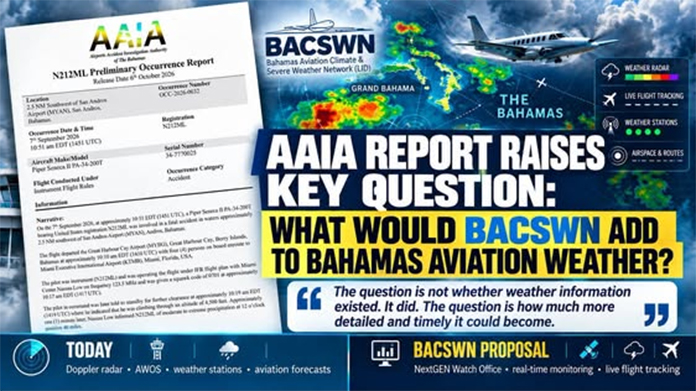
NASSAU| The Aircraft Accident Investigation Authority’s preliminary report into the fatal N212ML crash is raising a timely question in the ongoing BACSWN debate: could a next-generation aviation weather network give pilots more detailed information, sooner, than what is available today?
The AAIA report shows that weather warnings were already being issued before the September 7, 2026 crash near North Andros. The pilot was advised of moderate to extreme precipitation ahead and later reported rough turbulence shortly before contact was lost.
The Bahamas already has significant aviation weather infrastructure. The Department of Meteorology is the country’s official aviation meteorological service provider, while a network installed beginning in 2016 includes Doppler weather radars, airport weather observation systems and automatic weather stations.
BACSWN is proposing something more integrated, including a NextGEN Meteorological Watch Office, enhanced real-time weather monitoring and live aircraft tracking across Bahamian airspace.
That distinction could be important.
A traditional warning may tell a pilot that moderate or extreme precipitation is ahead. A more advanced integrated system could potentially provide a clearer picture of exactly where the strongest cells are, how they are developing and moving, and how an aircraft’s route relates to those conditions in real time.
That information could help pilots, controllers and operators make earlier decisions to divert, change course, delay a departure or avoid deteriorating weather.
The AAIA has not determined a probable cause, and its preliminary report does not suggest BACSWN could have prevented the crash.
But the report provides a real-world example of the kind of rapidly changing weather environment BACSWN says its proposed system is designed to better monitor.
The key question now is whether BACSWN can demonstrate that its network would provide greater detail, better coverage and faster aviation weather intelligence than the systems already operating in The Bahamas.
If it can, that may be the clearest explanation yet of what BACSWN is actually bringing to the table.