

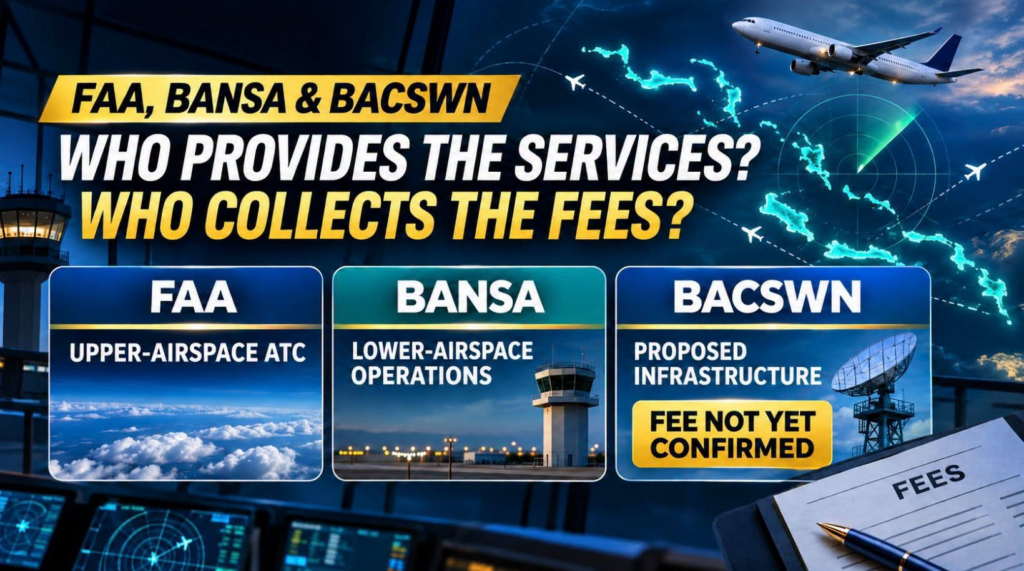
Claims that The Bahamas is collecting aviation fees for work performed by the US Federal Aviation Administration (FAA) have raised fresh questions about who manages Bahamian airspace and who should be paid for the services provided.
In comments reported by The Nassau Guardian, Airlines for America (A4A) President and CEO Chris Sununu criticised the Bahamas Air Navigation Services Authority (BANSA) for collecting overflight fees while the FAA performs air traffic control functions.
However, official records show that responsibility is shared.
The FAA provides air traffic control services in the northern portion of the upper Bahamian-administered airspace, while Cuba provides those services in the remaining upper portion. BANSA manages designated lower-airspace operations and other aviation responsibilities.
When The Bahamas introduced its aviation charging framework in 2021, the arrangement already accounted for services provided by the FAA and Cuba, with revenue also intended to support national aviation infrastructure.
Under the Chicago Convention, countries cannot charge aircraft simply for passing through their territory. However, legitimate charges for aviation facilities and services are permitted, subject to international charging principles.
The FAA providing services, therefore, does not automatically mean The Bahamas is improperly collecting fees.
A4A has also challenged proposed charges by the Bahamas Aviation, Climate and Severe Weather Network (BACSWN), questioning whether additional weather services are necessary.
Responding in The Tribune on November 9, BACSWN President and CEO Patrick Rollins rejected claims that the project would duplicate FAA services.
“The issue is not nor has it ever been one of duplicating existing FAA services,” Rollins said.
He cited an FAA-related aviation safety report identifying gaps in Caribbean weather radar coverage, arguing that BACSWN’s infrastructure would address longstanding deficiencies.
The project also extends beyond weather forecasting, with proposed aviation surveillance and monitoring capabilities that could strengthen The Bahamas’ aviation infrastructure.
An earlier proposed fee of $775 per flight has since been described by BACSWN as outdated, with a lower figure anticipated but not yet confirmed.
Meanwhile, the Government clarified on November 9 that ongoing BANSA negotiations concern existing overflight charges, not an additional fee.
The central issue is whether existing and proposed charges reflect the actual services provided, comply with international aviation rules and deliver measurable benefits to The Bahamas.
The question is not simply who collects the fees, but what airlines are paying for and whether those charges are justified.
Sources: BANSA Annual Report; Civil Aviation Authority of The Bahamas; Chicago Convention; The Nassau Guardian (November 6, 2026); The Tribune (November 9, 2026); Ministry of Energy, Utilities and Aviation (November 9, 2026).
#NewsGateBahamas#BahamasAviation#BANSA#BACSWN