
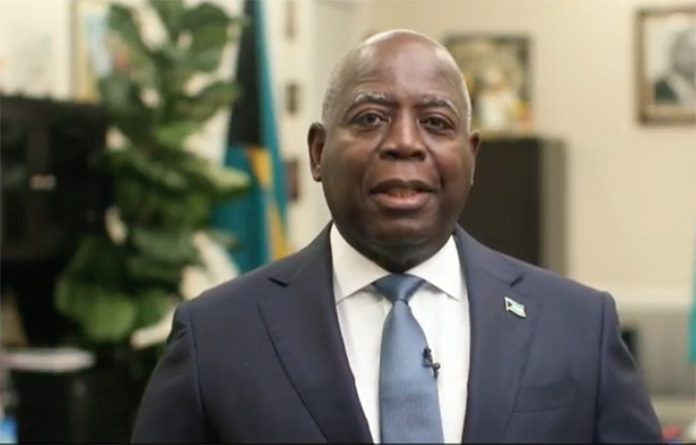
NASSAU, The Bahamas – Prime Minister the Hon. Philip Davis said big changes are underway at Bahamas Power and Light, but the country is still quite a way from that reality.
During a National Address on Monday, August 17, 2026, the Prime Minister detailed the country’s current energy infrastructure and its future as a system supporting families, businesses, and a better, bigger economy.
He explained that the The Energy system is made up of two separate, but connected parts:
- Generation and;
- Transmission and Distribution
“Therefore, adding more generation does not, by itself, keep your lights on. Generation is the engine.”
The Prime Minister said, “Transmission and distribution are the poles, the wires, the substations, the transformers and the cables that carry that power from the generators to your street and into your home.”
He said, “You can have every engine in the fleet running perfectly, and if an overhead or underground cable fails or a transformer catches fire at a substation, the lights will go out.”
The Prime Minister said this is what happened on July 30.
He explained that a transformer failure at the Blue Hills substation took the whole island down and it was not a shortage of engines.
“An underground cable fault caused the fire at a critical transformer. With an overhead line fault, a crew can often see. With a fault underground, they cannot.
“They must trace it, section by section, street by street, sometimes by excavation. That is why that particular repair took days instead of hours.”
The Prime Minister said it is not an excuse, but an explanation, because the public is entitled to know why – although it does not ease the misery all felt.
He also noted that these challenges are compounded by the global heat wave because of El Niño.
The Prime Minister said, “The demand on the system has broken our previous peak twice this season.”
He explained that heat not only raises demand and increases the strain on the equipment; it accelerates its deterioration.
The Prime Minister said the country is operating an old system in a new climate reality.
“And we do this on a chain of islands in the path of an increasingly violent hurricane season, in a world where energy supply chains are strained, and traditional short-term lead items have become long-term lead items and long-term lead items have become longer-term lead items as governments around the world race to upgrade their energy infrastructure.”