
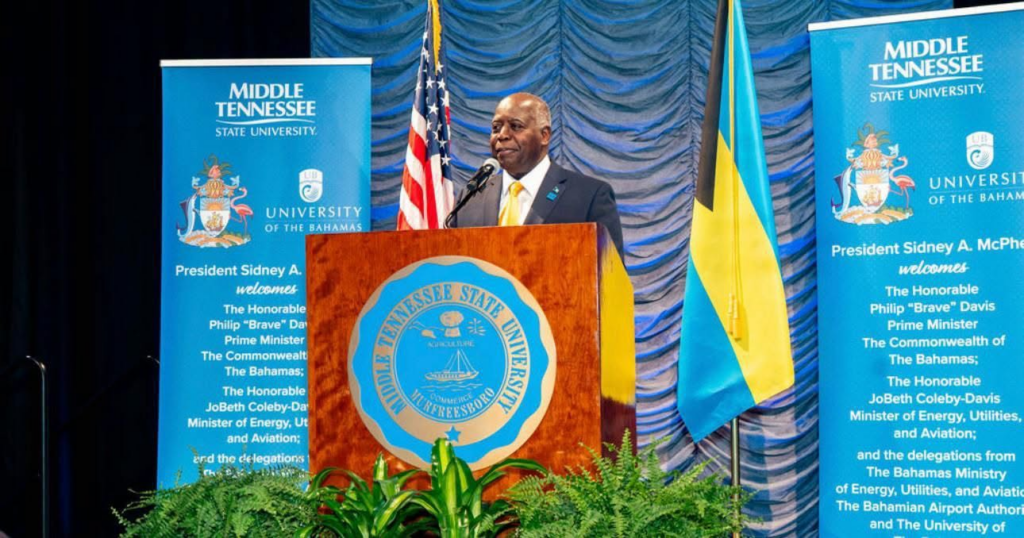
Murfreesboro, Tennessee | Delivering a lecture at Middle Tennessee State University, the Prime Minister set out how developing nations can secure fair terms in the digital economy.
Small nations must have a hand in writing the rules of the digital economy, Prime Minister the Hon. Philip Edward Davis KC MP said on Thursday. He was delivering a lecture at Middle Tennessee State University (MTSU) titled “Who Sets the Terms? Developing Nations and the Fight Against Digital Colonization”. Drawing on his years arguing cases in court, he framed the lecture as a case put to a jury of students.
The Prime Minister said every modern nation depends on others for technology, and that The Bahamas welcomes foreign investment, expertise and partnership. Dependence becomes a problem, he argued, when unequal bargaining power leaves a country with inadequate protections, few alternatives and little say over decisions affecting its people.
He described information drawn from ordinary lives as one of the most valuable commodities of our time, used to target advertising and train artificial intelligence. He asked who contributes that raw material, who controls its use, who captures the benefits and who writes the terms. Citizens hold rights over information about their own lives, he said, and governments, his own included, hold it only in trust.
Where bargaining power is badly unequal, the Prime Minister said, the digital age is repeating a colonial pattern. Value is drawn from the many and gathered by the few, he said, under rules the many did not write. He used the word colonization with care, acknowledging that the conquest, enslavement and violence his ancestors endured have no parallel in the digital age.
He pointed to the “sovereignty discount”, his term for the higher price a small country pays when the other side knows it has no alternative. His evidence ranged from undersea cables and the concentration of AI computing power to news blackouts in Australia and Canada.
On artificial intelligence, the Prime Minister described “a moment of great opportunity and profound danger”. He contrasted AI forecasting that gave early warning of Hurricane Melissa with harms caused where safeguards were missing, including to children. Small states need a voice in setting AI standards, safeguards and remedies, he said, or those rules will be tuned to larger markets.
The Prime Minister acknowledged the investment, expertise and economies of scale that international technology providers bring. Fairer contracts, regional cooperation, competition and effective oversight, he said, can keep those benefits while giving smaller nations a real voice. He added that digital sovereignty must also protect citizens from misuse by their own governments.
He set out a three-part response: representation, protection and capability. In September, he asked small island states to take a single position to the International Telecommunication Union’s Plenipotentiary Conference, which opens in Doha, Qatar, next week. The Bahamas has also nominated Stephen Bereaux for Deputy Secretary-General of the ITU.
At home, the Data Protection Act passed last December is coming into force in phases. A national committee is drafting the country’s first law on artificial intelligence.
The Government has used regulation to encourage investment in 5G, fibre and emerging satellite technologies. Planned measures include a Bahamas AI Academy with the University of The Bahamas and BTVI, AI lessons in schools from Grade 4 and a Nassau internet exchange.
The Prime Minister gave students five questions to ask before pressing “I agree”. Who collects their data? How is it used? Who receives it? Who profits from it? What control do they retain?
He encouraged them to review their privacy settings and to use their rights under Tennessee’s privacy law. Individual caution has limits, he said, which is why rights must be enforceable.
The Prime Minister paid tribute to MTSU President Dr Sidney McPhee, a Bahamian who has led the university since 2001. Dr McPhee will step down at the end of this year. The Prime Minister also honoured the memory of the late Mrs Elizabeth McPhee.
He invited students to build with The Bahamas through the university’s partnership, which will bring MTSU faculty to teach alongside Bahamian colleagues. “We have taken up this fight,” he said. “I ask you to join it.”