
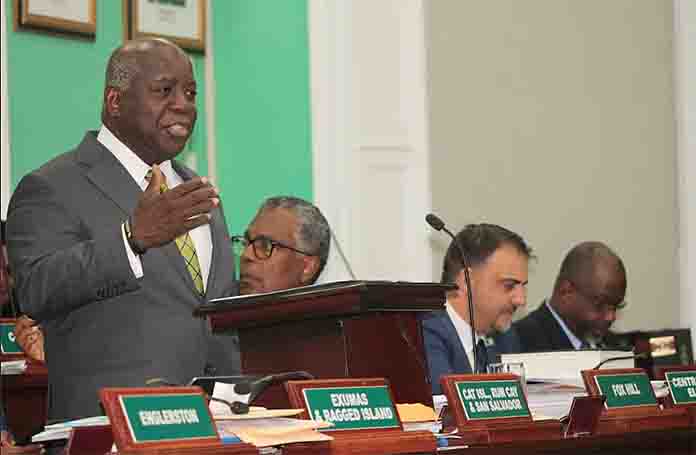
NASSAU, The Bahamas – During his Contribution to the Debate on the Climate Change and Environmental Advisory Unit Bill, 2025, and the Climate Change and Carbon Market Initiative (Amendment) Bill 2025, Prime Minister and Minister of Finance the Hon. Philip Davis said, on January 28, 2026, that the Bills gave “legal structure” to the work his Government did on Blue Carbon Credits.
“The Climate Change and Environmental Advisory Unit Bill 2025 establishes the Climate Change and Environmental Advisory Unit as a statutory body, continuing its existing work while giving it clear authority, defined responsibilities, and permanent standing within the Government,” Prime Minister Davis said in the House of Assembly.
“Under this Bill, overall responsibility for climate change and climate finance has been consolidated,” he added. “This reflects the reality that climate decisions simultaneously affect public finance, infrastructure planning, national security, and international relations.”
Prime Minister Davis noted that the fragmentation of responsibilities across multiple Ministries and agencies slowed and weakened his Government’s capacity to respond; whereas, consolidation within a single office allowed for “more efficient and effective action”.
“This Bill requires the development and regular review of a National Climate Change Policy, alongside a National Adaptation Plan, designed to reduce vulnerability and strengthen resilience across key sectors of the economy,” he stated. “These instruments guide how our Government plans, invests, and prepares for climate change in a small-island context, where the cost of unpreparedness is measured in lives and livelihoods.”
He added: “Through this Bill, we are also formalising inter-ministerial coordination by giving the Unit oversight of committees related to climate policy, climate finance, carbon markets, and sustainable development. This ensures that climate considerations are integrated into decision-making rather than addressed after damage has already occurred.”
Prime Minister Davis pointed out that a central feature of the Bill is climate finance governance.
“Climate Budget Tagging allows us to identify and track climate-related spending, while the Climate Change and Environment Fund provides a dedicated mechanism to receive and manage international climate finance, including grants, debt swap proceeds, and loss and damage resources,” he said. “These tools strengthen transparency and help ensure that climate funding supports national priorities.”
He added: “This Bill also clarifies The Bahamas’ obligations under the Paris Agreement by designating the Unit as the focal point for engagement with international climate institutions, including the UNFCCC, the Green Climate Fund, the Adaptation Fund, and the Fund for the Response to Loss and Damage.
“This strengthens our ability to meet reporting requirements and access financing.”
Prime Minister Davis noted that, when it came to Carbon Credits, that Bill provided governance and regulatory oversight for participation in carbon markets under Article 6 of the Paris Agreement.
“Under this Article, The Bahamas has committed to participating only in high-integrity, internationally verified carbon markets,” he said. “This Bill authorises the development of rules for mitigation activities, oversight of market participants, validation of mitigation outcomes, and bilateral and multilateral carbon market agreements.”
“The Bill also places Action for Climate Empowerment at the centre of the national response, supporting education, training, youth engagement, and public participation,” Prime Minister Davis added. “Because climate resilience cannot be built by institutions alone. It depends on informed citizens who understand both the risks they face and the role they can play.”
Turning his attention to the Climate Change and Carbon Market Initiative (Amendment) Bill 2025, Prime Minister Davis stated that it “aligns existing carbon market legislation with this governance structure”.
“It transfers responsibility for international climate reporting under the UNFCCC to the Prime Minister, reflecting the whole-of-government nature of these obligations, while assigning financial administration of carbon market revenues to the Minister of Finance,” he said.
“It also strengthens reporting relationships between the National Emissions Registry and the Prime Minister, ensuring clearer oversight and accountability,” Prime Minister Davis added. “Together, these Bills institutionalise and concretise climate change and carbon credit efforts within the Government.”
He noted that that was “a significant step forward” because “resilience cannot just depend on good intentions”.
“It must be built into law; and we are ensuring that happens today,” Prime Minister Davis said.
Prime Minister Davis pointed out that his Government arrived at that point with “the support, expertise, and passion of a number of talented people”.
“The trailblazers at the Climate Change and Environment Advisory Unit at the Office of the Prime Minister have been instrumental in the progress we have made thus far,” he said. “I want to say thanks to the efforts of Director Rochelle Newbold and her team.”
Prime Minister Davis added: “I must also acknowledge the groundbreaking work being done by the professionals involved in the Blue Carbon Expedition – and these are young people. Ramon Munroe, Nathan Richardson, Janelle Wilson, Ericka Harris, Kenneth Christie, Kevon Knowles, Nelson Johnson, Adrian Phillips, Jamie Ferguson, and BJ Bindle all made invaluable contributions to our work. There is also Theshala Mills, the architect of the state-of-the-art Blue Carbon Laboratory in Exuma.”
He also pointed out the work that the member for Mangrove Cay and South Andros Leon Lundy had done to “advance our national approach to Disaster Risk Management”, as well as the work of Executive Chairman H. Alexander Storr and Managing Director Aarone Sargent at the DRM Authority.
“I want to thank you all for the work you’ve done to get us to where we are today,” he said.
Prime Minister Davis stated that the challenge before The Bahamas was immense, and no single legislation or initiative could take it all on.
“The forces driving climate change are global, powerful, and largely beyond our control,” he said. “But how we prepare, how we govern, and how we protect our people are entirely up to us.”
Prime Minister Davis added: “We could continue with the policies of the past, reacting after disaster strikes and borrowing to rebuild what was already lost. Or we can build systems strong enough to reduce harm before it happens and smart enough to turn resilience into opportunity.
“One path leaves us permanently exposed. The other gives us agency.”
He pointed out that the long term, high-impact, and frequent damages caused by climate change tested more than existing infrastructure.
“It tests whether a nation plans only for the next budget cycle or for the next generation,” Prime Minister Davis said.
“Our vision is multi-generational,” he added. “That is why we are taking the time to do it correctly.”
Prime Minister Davis said that there could be no effective plan to build The Bahamas without “anticipating, preparing for, and leveraging the challenges posed by climate change for the good of our people”.
“Fortunately, this is nothing new for Bahamians,” he stated.
He added: “We adapt because success has always demanded it. We rebuild because community has always required it. And we endure because this country was shaped by people who understood that resilience is a part of our identity.”
Prime Minister Davis pointed out that he saw it growing up in Cat Island with his grandparents, making the best of what they had, and “they poured a lot of it into me”.
“And I see it in every corner of this nation, as I speak to people who demonstrate their resourcefulness and ingenuity on a daily basis,” he said.
Prime Minister Davis added: “Climate change will continue to challenge us. Storms will come. Seas will rise. But if we govern proactively and remain committed to our long term success, history will not remember The Bahamas as a victim of climate change. It will remember us as a country of overcomers that not only survived but thrived.”
He stated that he believed in the capacity of Bahamian people to make that happen because “it’s what we’ve always done”.
“And this administration is now moving in proactive ways to give our people the best shot possible at thriving in this new era,” Prime Minister Davis said. “That is why, when I travel the world, I continue to speak up for our nation, and for small island developing states everywhere. My sole focus is on protecting our people at home.”
He added: “The two Bills before us represent important steps toward strengthening our ability to adapt, build resilience, and ultimately make progress while saving lives and livelihoods from climate change. We will continue to do the important work of establishing the foundation that will be the difference-maker for our prospects as a nation for generations to come.
“My support for these Bills is in direct alignment with the achievements of this goal.”