
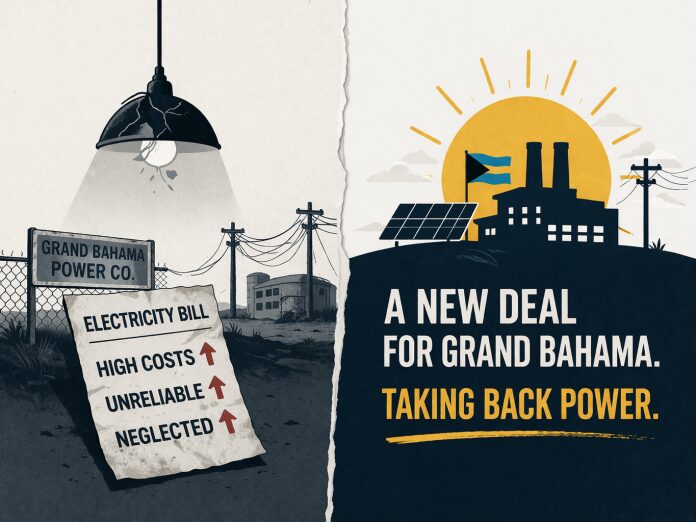
The Government’s decision to move forward with the acquisition of the Grand Bahama Power Company, backed by parliamentary resolutions to guarantee up to $280 million in borrowing, is a structural intervention in one of the most consequential sectors for the Bahamian economy: energy.
Predictably, the opposition has leaned heavily on the size of the guarantee, the exposure of public finances, and the principle of state involvement in utilities. These are legitimate questions, but they are incomplete ones. They ignore the deeper economic reality that has defined Grand Bahama for years: a dysfunctional energy system that has imposed hidden costs on households, discouraged investment, and entrenched inequality between islands.
At its core, electricity is not just another commodity. It is an enabling infrastructure. When it fails through high prices, instability, or underinvestment – it drags down everything else: business confidence, job creation, industrial recovery, and household resilience. Grand Bahama has lived with that drag for too long.
The Government’s move is a bold statement that they’re ready to address a problem that has been a burden for decades. Instead of continuing with a model that has failed to deliver price stability and reliability, the state is stepping in to assume control and, crucially, responsibility. That distinction matters. Ownership alone does not solve anything; governance does. But without control, meaningful reform is often impossible.
From an economic standpoint, the argument for intervention rests on three pillars.
First, the cost of living. Energy costs feed directly into inflation. Every business that pays high electricity bills passes those costs on. Every household absorbs them. Stabilising and eventually reducing electricity costs is not an abstract policy goal, it is one of the most immediate ways to ease pressure on Bahamian families. The acquisition creates the conditions for that stabilisation by giving the Government direct leverage over pricing structures and long-term energy planning.
Second, the investment climate. Grand Bahama’s economic revival has been a recurring national objective, yet it has consistently been undermined by structural constraints, chief among them energy. Investors do not commit capital into environments where operating costs are unpredictable and infrastructure is unreliable. Bringing the power system under national control is not just about today’s consumers; it is about sending a signal to future investors that the fundamentals are being fixed.
Third, equity. For years, consumers in Grand Bahama have faced higher electricity costs than those in Nassau. That disparity has never been economically justified in a modern, unified national economy. It has simply been tolerated. Correcting that imbalance is not only a social imperative but also an economic one, because uneven cost structures distort development across islands.
A $280 million guarantee is a serious commitment, and it will ultimately sit on the public balance sheet. Execution and governance will matter. But the greater risk, as often happens in public policy, is not in acting. It is continuing with a system that has already proven inadequate. And this is what Pintard and the opposition are advocating. They did the same in the case of GBPA, they are doing the same in this case.
There is also a broader strategic dimension to this issue and opposition needs to open its eyes. Energy markets globally have become more volatile, with oil price shocks translating quickly into domestic cost pressures for import-dependent countries like The Bahamas. A more controlled, reformed energy system, potentially with greater integration of renewables over time, offers a path to resilience.
The political framing of this decision will continue to dominate headlines: government versus opposition, risk versus responsibility, state versus market. But beneath that framing lies a more fundamental question: what kind of economic foundation does the country want to build for Grand Bahama?
If the objective is a low-cost, reliable, and competitive energy system that supports long-term growth, then the current move is a necessary, if complex, step in that direction. It is not a guarantee of success. But it is a departure from a model that has already failed to deliver it.
In that sense, the decision is less about ideology and more about pragmatism. So Pintard is again going against logic and progress. He needs to understand that not every topic, not every policy should be used for political gain. The Government is betting that control, combined with reform, can achieve what years of inaction did not. And he needs to be there to control the process, but not to block it.