

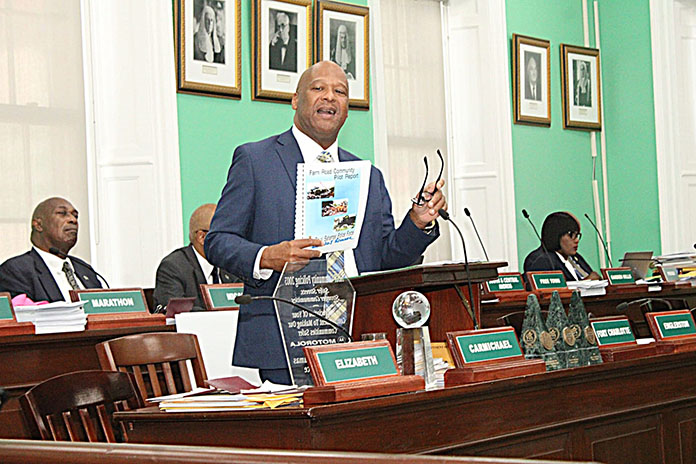
NASSAU| In his contribution, Minister Bell stated the starting point for the Bahamas Red Cross Society (Amendment) Bill 2025 lies in an important step taken by the Government on the 20th of September, 2022, when The Bahamas entered into a formal agreement with the International Federation of Red Cross and Red Crescent Societies concerning its legal status and operations within our jurisdiction.
He said: “That agreement, signed on behalf of the Government by the Honourable Frederick Mitchell, recognised the practical reality that the Federation plays a critical supporting role in humanitarian response in The Bahamas, particularly in times of disaster.
“At the signing were representatives of both organisations. As was stated at the time, the purpose of that agreement was to facilitate operational arrangements, strengthen cooperation, and allow humanitarian work to be carried out efficiently and without unnecessary delay.”
Minister Bell explained “what this Bill now does is give proper legislative effect to that agreement. While the agreement established the framework at the executive level, it is both prudent and necessary for Parliament to reflect that framework in statute. This amendment therefore updates the Bahamas Red Cross Society Act to formally recognise the role of the International Federation and to provide, in law, the immunities and privileges required for humanitarian operations to function smoothly. In doing so, Parliament is not creating something new, but completing a process that was agreed in 2022 and ensuring that our domestic law aligns with our international commitments and operational realities.”
He noted that “whenever the words “immunities and privileges” appear in legislation, it is natural that some persons may pause and ask questions. That caution is understandable. But it is important to be clear about what these provisions are, and just as importantly, what they are not. These immunities are not personal rewards. They are not shields for misconduct. They are practical legal protections that exist solely to allow humanitarian organisations to carry out their work quickly, independently, and without interference, particularly in times of national emergency.”
The work of the Red Cross and the International Federation, he said, often require rapid movement of personnel, equipment, supplies, and funds across borders and within disaster zones and within those moments, delays caused by legal uncertainty, taxation issues, or procedural barriers can cause lives.
Immunities provided under the Bill are consistent with international practice and are already recognised under the International Organizations (Immunities and Privileges) Act. They ensure, he said, that humanitarians can focus on relief, recovery, and care, rather than on navigating obstacles that have nothing to do with accountability or the rule of law.
“It is also critical to understand that these immunities exist alongside responsibility. The Bahamas Red Cross Society remains subject to Bahamian law, to its own governance structures, and to international standards of conduct. The International Federation operates under clear agreements with the Government and in coordination with national authorities. Nothing in this Bill removes oversight, weakens sovereignty, or places any individual above the law.
“What it does is protect humanitarian space, preserve neutrality, and ensure that help reaches people when they need it most.”
Minister Bell pointed out that in a small island state that faces hurricanes, flooding, fires, and other emergencies with increasing frequency, preparedness is not optional.
He said: “Updating the law to reflect how humanitarian response actually works in practice is a mark of responsible governance. This Bill ensures that when the next crisis comes, the focus will be on saving lives and supporting communities, not on technical barriers that Parliament could have addressed in advance.
“Madam Speaker, this Bill fits squarely within this Government’s wider approach to governance, which is to plan ahead, to prepare properly, and to put sound frameworks in place before they are tested by crisis. We do not wait for disaster to expose gaps in the law. We identify those gaps and close them responsibly. That is how serious governments operate, and that is how confidence is built among the people we serve.”