
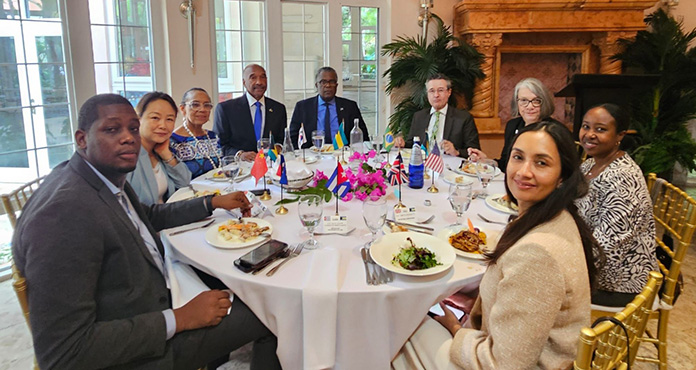
NASSAU, The Bahamas — The Hon. Fredrick A. Mitchell, Minister of Foreign Affairs of the Commonwealth of The Bahamas, welcomed Madam Kate Forbes, President of the International Federation of Red Cross and Red Crescent Societies (IFRC), as Guest of Honour at the recent Annual Honorary Consular Corps (HCC) Luncheon, where he expressed the Government’s appreciation to the Diplomatic Corps and Honorary Consuls for their continued partnership and service.
Minister Mitchell thanked members of the HCC and Diplomatic Corps for their vital role as bridges between policy and people, noting that in today’s complex global environment, diplomacy increasingly takes place on the ground and during times of crisis. He highlighted the unique contribution of Honorary Consuls as trusted local voices, problem-solvers, and first points of contact for nationals in distress, underscoring their importance to both effective diplomacy and humanitarian action.
The Minister also recognised the leadership of the IFRC and the Bahamas Red Cross Society, commending their work in disaster preparedness, emergency response, and year-round community support. He reaffirmed The Bahamas’ commitment to International Humanitarian Law (IHL) and international humanitarian principles, and referenced the recent passage of the Bahamas Red Cross Society (Amendment) Bill as a key step in strengthening national frameworks for cooperation and disaster response.
Reflecting on regional solidarity, Minister Mitchell reiterated The Bahamas’ support for recovery and humanitarian assistance efforts in Jamaica following Hurricane Melissa in October 2025, emphasising that recovery is a long-term process requiring sustained engagement well beyond the immediate aftermath of disasters. He stressed that preparedness — including pre-positioning resources, early financial assistance, and coordinated planning — saves lives and accelerates recovery, and that integrity, transparency, and clear operating procedures are essential to ensuring aid reaches those most in need.
During his address, the Minister outlined the government’s Foreign Policy Priorities, centred on climate action, peace and security, economic diplomacy, South-South cooperation, and public diplomacy. These priorities focus on maintaining Bahamian leadership in climate diplomacy; strengthening dialogue and partnerships to address security challenges; advancing national development through trade, investment, and the blue and green economies; deepening cooperation on food security, public health, technology and AI; and ensuring that Bahamians are engaged and informed through cultural, educational, and civil society exchanges.
He further highlighted The Bahamas’ Multilateral Policy Priorities, including strengthening participation in the United Nations and upholding a rules-based international system; advancing regional and values-based alignment through CARICOM, the Organization of American States, the Association of Caribbean States, and the Commonwealth; pursuing partnerships for peace and security through South-South cooperation; and promoting Bahamian global leadership, including candidatures for a UN Security Council Non-Permanent Seat (2032–2033) and Deputy Secretary-General of the International Telecommunication Union (ITU).
On consular affairs, Minister Mitchell outlined the government’s focus on enhanced service delivery, modernisation and digitalisation, strengthening support for Bahamians abroad, and improving transparency and cooperation with partner agencies. Initiatives include expanded access to digital appointment platforms, improved case tracking, greater data analysis to inform policy, increased inter-agency coordination, and enhanced capacity to assist nationals in distress regionally and globally.
In closing, Minister Mitchell thanked the Honorary Consular Corps and Diplomatic Corps for the bridges they build and the trust they uphold, reaffirming that The Bahamas values these partnerships deeply. He reiterated the Government’s commitment to being prepared, resilient, and united in the face of future challenges, and to working alongside humanitarian partners and the international community to advance peace, security, and sustainable development.