
FREEPORT: In Freeport, for the first time in its political history, campaign signs have been effectively banned. On paper, the GBPA directive applies to everyone. Every party, every candidate, every roadside banner and poster has been swept into the same category. But in reality, GBPA is trying to help out Pintard and FNM.
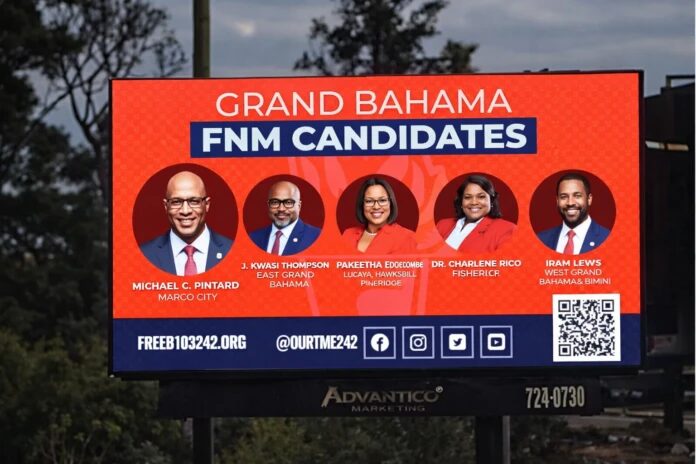
Because while physical signs have disappeared, political messaging has not. Prior to the enforcement of this new rule, the Free National Movement had already secured a dominant presence across Freeport’s digital billboard network, the most visible, high-impact platforms in the city. They are positioned along major roads and high-traffic areas where visibility is guaranteed.
So now, in Freeport only FNM billboards are seen, and GBPA somehow for the first time decided to ban all other forms of outdoor advertising?
The GBPA decision to enforce the removal of physical campaign materials has directly reshaped the communication environment of the election. And while the rule itself may be framed as neutral, its consequences are anything but. By eliminating the most accessible form of political expression for all candidates, while leaving intact a pre-existing dominance in digital advertising held by one party, the authority has, intentionally or not, altered the balance of visibility.
The political context matters
In recent months, Pintard has been notably vocal in defense of the GBPA’s authority and autonomy. At a time when a historical tribunal decision has been made reasserting greater state control over Freeport or recalibrating the balance of power, Pintard has taken a clear stance against such moves.
The media have published other information that further supports the speculation that Pintard has been GBPA advocate for a long time. Namely, the last FNM’s campaign, according some reports, has been funded with 5 million dollars by the GBPA and Pintard’s wife at the same time works in one company that is owned by GBPA.
In his recent public appearances, Pintard has argued, consistently, that Freeport’s unique governance structure should be preserved, and that the GBPA’s role remains essential to the city’s identity and economic function.
That alignment, whether ideological or strategic, now sits alongside a campaign environment in which the GBPA’s actions have had a tangible effect on electoral visibility. It creates a convergence that is difficult to dismiss as coincidence. On one hand, a candidate publicly supports the continued authority of an institution, on the other, that same institution enforces a policy that, in practice, leaves his campaign with a singular advantage in how it reaches voters.
For voters moving through Freeport today, the experience is markedly different from previous elections. The visual noise of campaign season has been quieted, replaced by a more controlled and selective form of messaging. And in that quieter space, one campaign’s voice carries further than the rest.
Whether this reflects coordination, coincidence, or simply the unintended consequences of policy is a question that lingers. What is clear, however, is that the mechanics of visibility, who gets seen, who gets heard, and under what conditions, have shifted in a way that matters.
And in politics, as in journalism, it is often these shifts, subtle at first glance, that tell the most important stories.