
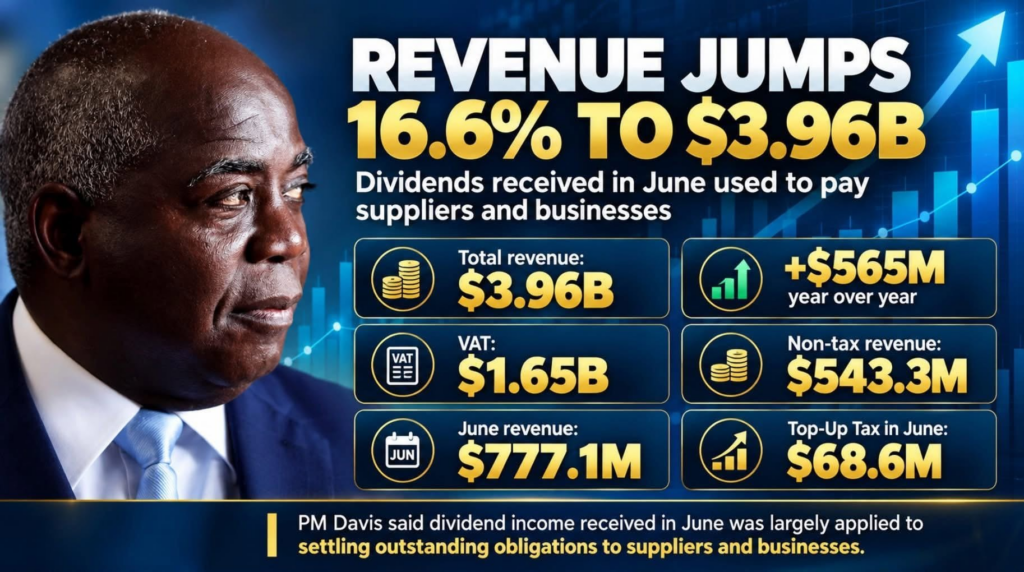
NASSAU| Government revenue increased by $565 million to reach $3.96 billion during the 2025/2026 fiscal year, with Prime Minister Philip Davis saying dividend income received in June was largely used to pay outstanding obligations to suppliers and businesses.
The $3.96 billion collected represented a 16.6% increase over the previous fiscal year and placed revenue 1.7% above the Government’s budgeted target.
Davis disclosed the figures while tabling the Ministry of Finance’s June 2026 Monthly Fiscal Summary in the House of Assembly on Wednesday, October 14.
“Total revenue for FY2025/26 reached $3.96 billion, an increase of 16.6% over the previous year and 101.7% of budget,” Davis said.
Tax revenue increased by 13% to $3.42 billion, with Value Added Tax remaining the Government’s largest single revenue source.
VAT collections rose 14.9% to $1.65 billion, while taxes on international trade and transactions increased 4.3% to $908.9 million.
Non-tax revenue climbed 45.4% to $543.3 million, driven primarily by higher property income and increased collections from the sale of government goods and services.
The strongest monthly revenue performance came in June, when the Government collected $777.1 million. That was an increase of $467 million, or 150.7%, compared with June 2025.
The June increase did not come from one source.
Tax revenue rose by $307.2 million, including a $135.2 million increase in VAT collections that included the settlement of outstanding arrears.
Taxes on financial and capital transactions increased by $35.3 million, mainly because of stamp duty collected on share transfers.
International trade and transaction taxes increased by $44.4 million, supported by departure-tax and excise-duty receipts.
Non-tax revenue for June rose by $159.8 million, driven largely by dividend receipts.
“The dividend income received in June was largely applied to settling the Government’s obligations to suppliers and businesses,” Davis said.
“An administration that inherited unpaid obligations across the economy is now steadily clearing them, and the benefit reaches contractors, merchants and their employees.”
The Prime Minister did not identify which government-owned entities paid the dividends, disclose the amount received from each entity or provide a breakdown of the suppliers and businesses that were paid.
He also did not state the total value of outstanding obligations still owed by the Government.
The figures consequently show that some of the Government’s strong June performance came from collections and receipts that may not recur at the same level every month, including VAT arrears, stamp duty on share transfers and dividend income.
Davis said the broader increase in revenue resulted from improved tax collection and compliance rather than additional financial pressure being placed on households.
“This Government chose to strengthen revenue by improving collection and compliance rather than by imposing new burdens on households already under pressure,” he said.
The new Domestic Minimum Top-Up Tax on qualifying multinational companies also contributed $68.6 million in June. The measure applies a minimum tax rate of 15% to large multinational groups operating in The Bahamas.
Government expenditure also increased during the fiscal year, rising 12.6% to $3.92 billion. However, because revenue grew at a faster rate, the Government reported a preliminary fiscal surplus of $39.3 million.
The revenue figures do not mean individual Bahamians paid 16.6% more in taxes. The overall increase came from several sources, including VAT, international trade taxes, corporate tax collections, arrears, fees, property income and dividends.
The unanswered questions surrounding the June dividends and supplier payments remain significant. A full assessment will require disclosure of which public entities provided the funds, which obligations were settled and how much the Government still owes suppliers and businesses.