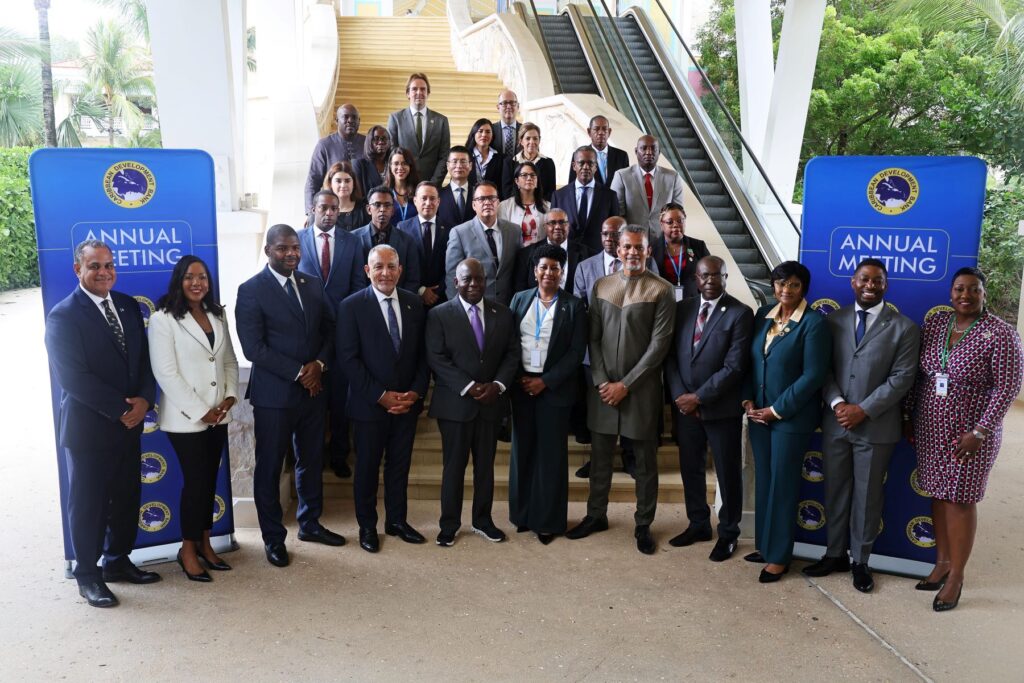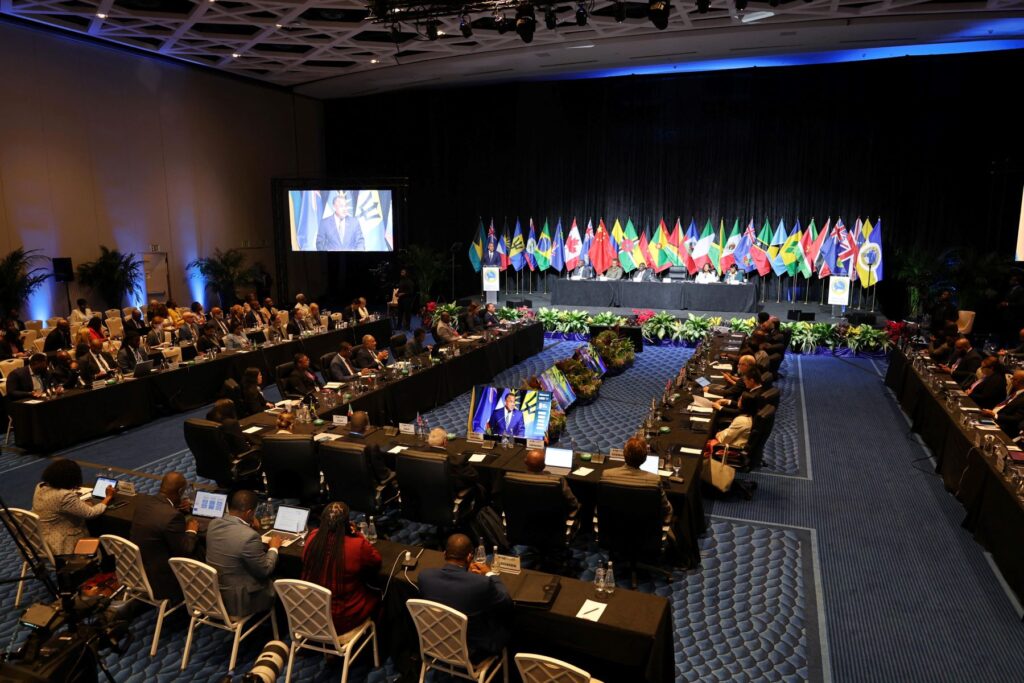

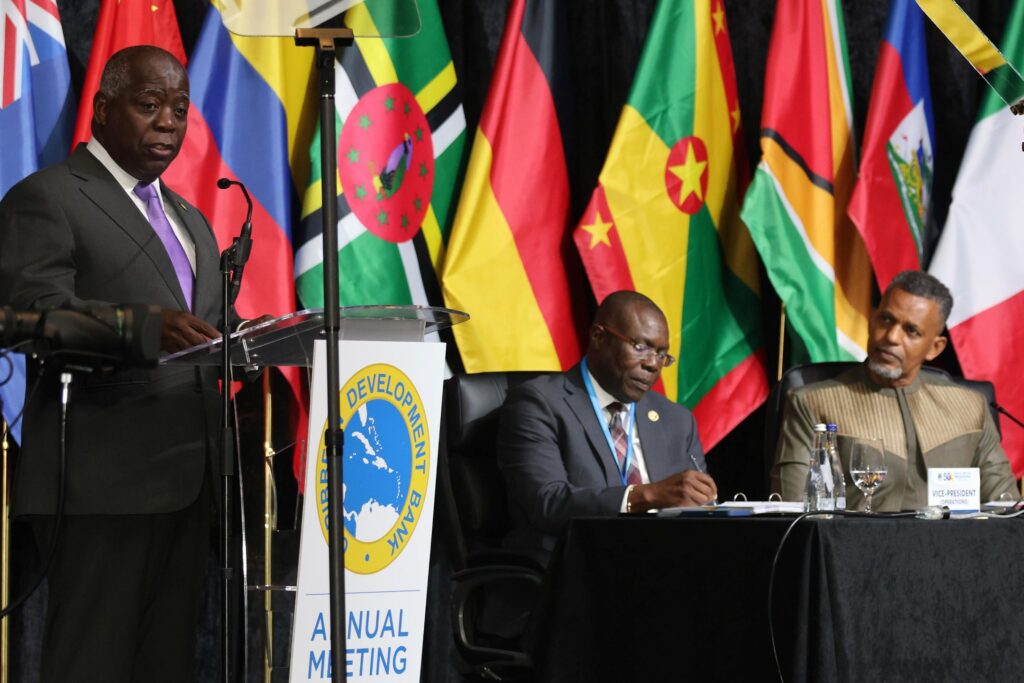
NASSAU, The Bahamas – During his Official Remarks at the Opening Ceremony of 56th Annual Meeting of the Board of Governors of the Caribbean Development Bank, on June 3, 2026, Prime Minister the Hon. Philip Davis welcomed all those in attendance to The Bahamas, adding that they had come to a nation that saw that bank as “one of our own”.
“It was built by our region,” he said, at the event held at Baha Mar Convention Centre. “It answers to our region. It carries the purpose of our region.”
Among those present were Deputy Prime Minister and Minister of Education, Science and Technology the Hon. Chester Cooper; President of the Caribbean Development Bank Daniel Best; Chairman of the Board of Governors and Minister of Finance, the Hon. Michael Halkitis; Governors and Ministers of Finance; Minister of Economic Affairs Senator the Hon. Jerome Fitzgerald; Heads of Delegation; Senator and Attorney General & Minister of Legal Affairs Senator the Hon. Wayne Munroe; Permanent Secretaries and other senior Government officials; members of the Diplomatic Corps; and regional and international stakeholders and young people.
Prime Minister Davis added: “We have called this gathering ‘Forging the Caribbean’s Future’. It is a strong theme; but we should be honest from the start, because honesty is the only foundation that holds. You cannot forge a future with borrowed fire.”
He pointed out that the world, as it was, had grown smaller, not larger. Capital that once moved freely “now hesitates at our shores”.
Prime Minister Davis said: “Our banks lose correspondent relationships, and our businesses are cut away from a financial system the rest of the world takes for granted. We are told, often at the same time, that we are too small to matter, on the one hand, and too prosperous to be helped, on the other.
“A single storm can erase a year of our national income in one night,” he added. “That same storm can disqualify us from the financing we need to recover, because a formula written in a distant capital has decided that we are ineligible because we have graduated.
“Let me say in the sincerest terms. We do not feel like graduates when the seas around us are rising.”
Prime Minister Davis noted that climate finance, when it arrives, comes late; and too often, it “comes as a debt burden of our state”.
“So we rebuild,” he stated. “We borrow to rebuild; and the debt we carry crowds out the schools, the clinics, and the ability to invest in other opportunities we owe our people.”
Prime Minister Davis added: “This is the world as it is. You know it. I am here to name it honestly, because no lasting progress is built on a borrowed truth. We also have to be honest about ourselves.”
He said that, for too long, they had treated endurance like achievement.
“We have survived hurricanes and pandemics, debt and downturns, and we have called that strength,” Prime Minister Davis stated. “It is strength; but, this morning, I must say the harder thing.”
He continued: “We have been resilient for so long that we have begun to mistake survival for progress. Surviving the storm is different from changing the conditions that create it. Enduring the old order is different from building a better one. A region that learns only to survive will be asked to survive again, and again, and again, until survival is the only thing it knows how to do. And I say ‘we’ without exception, because The Bahamas lives with this same reality. We, too, have lived as tenants in a house we did not build, following rules drafted in rooms where we had no seat.
“I am here as a leader who believes the time to build has arrived.”
Prime Minister Davis said that that was the truth at the centre of their gathering.
“The global financial architecture was not designed for us,” he said. “It was designed without our storms, our scale, and our future in mind. We have been tenants of this architecture across generations; and the rent keeps rising. The rules keep changing without our consent; and no outside power is coming to fix it for us.”
He added: “So we are left with one clear path. I ask every Governor in this hall to consider: If we will not write the rules of our own financial future, then we will be left only to discover how to survive within the rules of others. Those who refuse to write the rules will, in the end, become tenants, subjected to a state of perennial survival. There is no easier path. We simply wait for the house to repair itself; and we cannot do that.”
Prime Minister Davis pointed out that the Caribbean region was not the first to face that choice; and shared a story that he said might be “the most important thing I say to you this morning”.
“Africa faced this same choice,” he noted. “African nations were told what we are told – too great a risk, too fragmented, too small to be financed at scale – and Africa made a choice.”
Prime Minister Davis added: “Africa did not knock louder. Africa built its own door. They founded the African Export-Import Bank, Afreximbank, an institution to finance African trade on African terms. They did not wait for permission. They began the work themselves.”
He continued: “Look at what that institution can do now. This year, Afreximbank raised its commitment to our region from three billion United States dollars to five billion. More than seven hundred and fifty million has already reached the Caribbean. A pipeline of more than two billion is still to follow.”
Prime Minister Davis pointed out that the Afreximbank was building a trade centre in Bridgetown; and they had turned their attention to something that should get the attention of everyone in that room: the creation of a Caribbean Export-Import Bank.
“A Caribbean Eximbank — an institution that could finally be our own,” he stated.
Prime Minister Davis added: “We should be clear about what this means. It was not charity passing down from north to south. It was solidarity rising from south to south. It was one part of the global majority saying to another, ‘We have built our own house. Now we will help you build yours’.”
He stated that Africa did not wait; and the only question that remained was whether the Caribbean region will wait.
“And I know what gives some of us pause,” Prime Minister Davis pointed out. “It is not the cost of building. It is, what I call, a quieter doubt: the doubt that we can act together at all.”
He added: “There are some, even in this room, who feel the pull of a familiar temptation — to place one nation first, to pursue the national interest alone, and to leave the regional interest to fend for itself. I understand that temptation. Every leader here answers first to their own people. That is not a weakness. It is the duty of office.”
Prime Minister Davis quoted an African proverb that he said spoke directly to that moment.
“If you want to go fast, go alone,” he said. “If you want to go far, go together.”
“The Caribbean has never needed speed,” Prime Minister Davis added. “The Caribbean has always needed distance. And no single one of our economies, no matter how determined, can travel that distance on its own. So we must not allow ourselves to be turned against one another, competing for the same scarce capital, the same investor, the same narrow advantage, while the architecture that disadvantages every one of us is left untouched.
“When we are set against each other, we never win.”
He pointed out that they must not tear down the institutions they had only begun to build for themselves.
“CARICOM is the first house we built together,” Prime Minister Davis said. It is not finished. It is not perfect. No union of free nations is ever perfect; but you do not abandon the house you are building because the work grows harder, or because a door begins to stick. You stay. And you finish it.”
He added: “Where our union is weak, we should strengthen it. Where it is broken, we should repair it. Where it has fallen short, we should not walk away. We should ask the harder question of how to make it work.”
Prime Minister Davis stated that whether they choose to act together or apart “one truth will not bend to our preference”.
“The same tide that lifts one of our islands lifts them all,” he said. “The same storm that floods one of our shores threatens every other.”
Prime Minister Davis added: “We may sail under different flags; but we are passengers in the same vessel. No one bails water from one end of a sinking ship and claims he is safe. Some will say that this kind of ambition is wrong for uncertain times. I believe the opposite. Uncertainty is the reason to build. A sailor does not wait for calm water to learn his craft. He learns because the sea will never be still.
“So let me be practical, because a vision without a plan is only an idea. We must pool the strength we already have.”
He stated that no single Caribbean economy can finance its future alone.
“Together, we are a market the world has every reason to take seriously,” Prime Minister Davis said. “It is no longer enough to be a region the world is willing to invest in. We must become a region willing to invest in itself.”
He added: “We must no longer accept that a credit rating built for a continent should decide the fate of an archipelago. We must create tools of our own — regional guarantees, blended finance, mechanisms that reward our resilience instead of punishing our geography. We should be measured by the future we are willing to finance, not by the disasters we are forced to survive.”
Prime Minister said that they must use the institutions they already have, beginning with the Caribbean Development Bank.
“The Strategic Plan of this Bank, for the years 2026 to 2035, gives us a foundation,” he said. “We should build on it, not around it.”
Prime Minister Davis added: “And we must invest in the one asset that no agency can ever downgrade, and that no storm can ever wash away: the mind of a Caribbean child. We owe our young people far more than survival. We owe them prosperity. And we owe them something even more powerful – a reason to stay in the region. Today, too many of our brightest leave these shores and do not return, because the future they want is being built somewhere else. Every gifted mind that leaves tells us something about the future we have offered them.
“We must change that verdict.”
He said that they all owed their children more than a region to inherit.
“We owe them a region worth staying for,” Prime Minister Davis stated.
He added: “We should give them an education that teaches more than endurance. It must teach them to be curious, to question, to imagine, and to compete with any mind, in any place, in a world that changes faster than any curriculum can follow. A region that values curiosity is a region that can never be left behind.”
Prime Minister Davis said that the future would not belong to those who simply endured it. It would belong to those who dared to build it, he added.
“So let me be clear about where we now stand,” he continued. “This is not a storm to be waited out. It is a tide that has already turned.”
Prime Minister Davis said: “We do not seek a finer room in another’s house. We are laying a foundation of our own. We do not ask for a seat at a table that others have set. We are building the table. And we are no longer the small, the vulnerable, the high risk on another’s ledger. We are the place where the Caribbean comes to forge its future. That is the name written on the door of this gathering.
He stated that that should become “the name on the door of the house we build”.
Prime Minister Davis said: “So what does this ask of us? It asks us to accept that resilience is no longer enough. Surviving a shock is not the same as shaping a future. A region that only endures will remain poorer, more fragile, and more dependent than it needs to be.”
He added: “And what must we now do? We must build. We must deepen our partnership with Afreximbank, for example. We must move from speaking of a Caribbean Eximbank to bringing one to life. We must give this Bank’s plan our political will, not polite applause. And we must finance the ambition of our children with the same seriousness we give to our debt.”
Prime Minister Davis stated that they could not build the future of the Caribbean on the old order.
“That order is passing, and nostalgia for it is no strategy at all,” he said.
“This must be the era of possibility; but possibility is not a feeling we talk into existence.” Prime Minister added. “It is an institution we build – with a balance sheet, with a building, and with a name.”
He stated that they all had been tenants long enough.
“We are no longer asking for the keys to a house we did not build,” Prime Minister Davis said. “We are laying the foundation of one that we will.”
He added: “History should not remember us as the generation that survived the old world. It should remember us as the generation that built the new one. To every nation of this region ready to do the work, I say this morning: The Bahamas will build it with you.
“Thank you. Together, let’s forge this future — with our own fire, and with our own hands.”